Good Death?

I called in last night for the opening of the new Spiritual Care Centre at Perth Royal Infirmary.  Hospital chaplaincy is one of the things that I do miss from the past – not that I’d want to do it every day.  Just now and again.  One of the chaplains reminded me that I once said to him that I thought it was the purest form of ministry – and I think it is.  You are often with complete strangers.  No history and no baggage.  You are dealing with deep and difficult stuff – so all the peripheral things vanish and you can’t take refuge in anything institutional or formulaic.  It’s sometimes the middle of the night – so you’re sort of disconnected in time and space.  In a curious way, people and their families are at their very best – often little short of heroic.   Faith?  Tested to its extreme and down to the bare necessities – God? God’s will?  Love?

So I’ve been thinking as I have been reading today about Debbie Purdy who won her case in the House of Lords.  She said that she was ‘esctatic’ at the ruling and that ‘she had been given her life back’.  Which is a sort of ironic thing to say in the circumstances – since she wanted to know if her husband would be prosecuted if he helped her to go to Switzerland to end her life when her MS progressed to a point at which her quality of life was gone.

You won’t be surprised that I think this is not a great thing to do.  I’ve seen enough to have got beyond any sort of ‘peace and starched white pillows’ attitude to illness.  More often, however great my desire to offer support and comfort, I’ve felt real anger at what terminal illness does to people .. seen illness as an enemy .. listened to people describing what it is like when you own body turns against you.

So my first feelings about assisted suicide aren’t actually moral objections – I can easily envisage situations in which it would be at least an understandable course of action, even if not one that I agree with.  It’s more that this is one of those things which is relatively clear at the extremes – loss of dignity, pain, loss of control, minimal quality of life.  But it’s not at all clear in the middle – and that’s where the pressure, not being a burden factors begin to play.

Gatherings

Interesting to see the various gatherings here in Scotland over the past few days.  Diageo’s workforce and surrounding community created an extraordinary demonstration to try and save jobs in Kilmarnock.  I feel for them – what else can they do?

Meanwhile the great Gathering took place at Holyrood Park.  And there is a gathering discussion about the Scottish diaspora and how it might become a continuing part of Scottish life.  I’m all for that.  After all, the Irish diaspora has been a ‘big thing’ in Ireland – who could forget former President Mary Robinson who put a lighted candle in the window for the diaspora – many of whom left Ireland only because Ireland had nothing to offer them.   Connecting with the diaspora is clearly a ‘good thing’.  Except of course that the Irish diaspora in America became politicised – many became what the late and great Conor Cruise O’Brien called the ‘sneaking regarders’ of violence.  One of the building blocks of the settlement was the work done by people like John Hume and Senator Edward Kennedy to wean Irish-America away from its willingness to support politically-motivated violence in Ireland.

For the rest, I’m aware of two speed issues today.  The first, after a weekend of tragedy, is the beguiling beauty and innocence of Scottish roads.  The faithful Passat and I – and everybody else – should take extra care.  The second of course is the vexed question of broadband speeds.  Blogstead’s asthmatic but reliable connection comes from the exchange in Kinrossie – which is 7 km away.  The very people who might most quickly adopt tele-conferencing instead of travelling long distances to meetings are inhibited by slow broadband speeds.  We need a campaign.  But yesterday I did manage a Skype session from our office in Perth with my American ‘coaching bishop’  in California – both sound and pictures.

Connections

My Thought for the Day tomorrow says that part of my job is about making connections.  So I am pondering the connection between the Clan Gathering in St Andrews – part of New Wine Scotland – at the start of the day and the Black Watch Cocktail Party at the end.  There must be a connection.

But the day started with what Radio 4 charmingly described as ‘Hatch ‘n’ Match’  That’s the CofE’s [neighbours over the hedge again] somewhat unradical proposal to slip the odd baptism into the odd wedding.  So I cruised off through the dawn of the Blogstead safari park – deer leaping over the hedge at Saucher; had to stop for rabbits all over the road at Abernyte; some clergy vacancies in Scotland if you are interested – to discuss it all with BBC Scotland down the line in Dundee at 6.55 am.  At least it gave me the chance of talking about our presence at Wedding Fairs and the like.

And on to the Clan Gathering – which of course was full of Piskie people and full of interest.img_0387

Here I am with Elaine and Angela from our congregation at St John’s, Alloa – img_03881and with Rev Malcolm Round from our congregation in Balerno.  I really enjoyed the opportunity of meeting keynote speaker, Mark Stibbe

So the big question remains.  What is the link with the Black Watch Cocktail Party.  There must be one

Well all I can offer is ‘full of Piskie people and full of interest.

Why use the bridge?

dsc01244

We have a sort of programme of visiting [the rather large amount of] Scotland which lies north of Ballintuim.  So Anna’s visit this weekend was a pretext for a quick visit to Skye – which I haven’t seen since a far off visit as a student.

Started in the palindromic village of Glenelg, which isn’t on Skye at all.  But the chance of taking the equally palindromic Anna there was too good to miss.  We stayed with Catriona, the local Registrar of Marriages.  The Glenelg Inn was fascinating – we found ourselves in the middle of a session of traditional music of the very highest standard.  And some of the local children seemd quite confident about joining it.  I sat there thinking that I must learn to do the traditional fiddle – after I have satisfied my yearning to play the saw.  And I thought about how a living tradition is sustained in an all-age community.  I could see the commitment of the small number of parents which made that possible.

In the morning, we used the ferry across from Glenelg – which starts from the reconstructed Sandaig lighthouse which used to stand near Gavin Maxwell’s house [of Ring of Bright Water and the otters].  Time to chat with two of the happiest people you could meet who run it on behalf of the community.  As you can see in the photo, the ferry was also palindromic – having the useful attribute of being able to turn all the passengers round to face in entirely the opposite direction.  So I thought about that too.

Yes we did go to Skye.  The scenery is magnificent but it rained.

Balanced life?

house-martins

Strange sort of day really.  Cast an eye upwards above the Blogstead kitchen window and you find the next generation of House Martins ready to fly – indeed they are already flying.

Elsewhere, Tiger tees off at Turnberry.  We managed a delightful cycle around Glen Isla – having carefully scrutinised the map for contour lines before setting out.

And I’m cruising the websites – trying to learn about what’s happening at TEC’s Convention at Anaheim.  It’s a bit like TUC Conferences of old – what is the relationship between Resolution D025 and Resolution B033 of 2006?  Behind that arcane question lies the need to understand whether they are simply ‘saying where we are as a church’ or saying something more serious about the Anglican Communion moratoria.  After two weeks of it, I should think they are all exhausted.

Chop?

It’s hard not to peep over the hedge sometimes to see what the neighbours are talking about.  Some are mooting  a sort of episcopal cull to match the diminishing numbers of clergy.

Which is interesting, of course because, if the CofE had as many bishops as we have per Piskie, as it were, they would have hundreds and hundreds of them.  And that in turn brings us back to that ever-pressing question, ‘So what do you do all day?’

I am still at heart the parish priest that I was for almost thirty years.  So I’m not a great fan of bishops as a class. I suspect that good parish priests will get on with it – others will flounder – and a bishop or fifty more or less won’t make a whole lot of difference.

And yet, as a paid up member of the Anglican Gamekeepers’ Association, I can see that we are no longer living in the relative simplicities of christendom.  No I know it wasn’t simple … but let that pass for a moment.  These are difficult times for the church and for clergy and people need more support than they did in the past.  I hope our clergy feel that in some kind of way I’m in the trenches with them – but you’ll have to ask them that yourself.

For what it’s worth, I’m more and more inclined to feel that there are only two things that matter much at present.  I’ll settle for leadership and holiness.  Any offers?

With TISEC

Spent three days this week with our students at TISEC – Theological Institute of the Scottish Episcopal Church.  This was their annual Summer School when they spend a week together in the monastery at Kinnoul.  That in itself is a heart-warming experience for me as it is a little outpost of ‘Ireland in Scotland’ complete with its Mrs Doyle person … ‘Would you not have a little more of the strawberries and cream, Father …?  Ah, go on …’

It’s good to get in amongst the people and take the measure of who they are, where they come from and what their hopes and dreams are.  Training for ministry has a tendency to become politicised in all churches and the SEC is no exception to that.  There is so much at stake – the training process shapes the future shape and character of ministry and has a big impact on the shape and character of the church itself.

I offered them ‘a bit of this and a bit of that’ in some short offerings at Evening Prayer.  It comes down to the ‘seductions of ministry’.  We all try to be devastatingly competent.  But committed and caring people tend to want to ‘fix’ things in people’s lives.  And of course the whole point of ministry is that it often deals with things which by definition cannot be fixed.  And then there is the insidious feeling that one might actually be good at the ministry business – summed up for me in the immortal lines:

Float like a butterfly/Sting like a bee

I am the greatest/God bless me

Reform

I was interested in the article by James Walters – ‘Instinctively conservative and bound by ritual’ – in this week’s Church Times.  He suggests that parliament faces some of the same questions as the Church in its struggle to reform itself.

He identifies four problems … of which the first has a certain interest for me at this moment.  It’s the ‘simplistic reduction of an institution to its leadership.’  Meaning the tendency to intensify blame on leaders when things go wrong and invest unrealistic hope in those who replace them.

He also refers to the resistance to reform even among those who are ostensibly most progressive.

I often ask myself the question, ‘I am bishop of a small diocese in a small church.  Why am I so busy?’  Some of the answer, I suppose, is that however small the diocese or church there is an irreducable minimum of work involved in the engagement with society, the wider church, the ecumenical context, etc.  And we attempt to have an intensity of contact and engagement which would not be possible elsewhere.  But still… the meetings, the time, the difficulty of visualising how things might be other than they are, the huge investment in things as they are …

When I was a parish priest, I used to attempt to measure how much time I spent actually in contact with people.  I was never happy with the answer.  So Walters suggests, ‘MP’s are incredibly busy, but do not actually do very much.’  Rather like Gilbert’s nice line, ‘The House of Peers throughout the years did nothing in particular and did it very well.’

Whale-watching without whales

A bit rushed these last few days – the juxtapositions of things become ever more interesting.  You may be interested in this interview which I did with my blogging friend, Mad Priest.

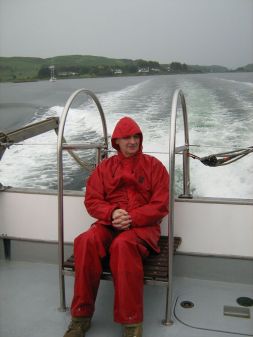
The end of the week brought two events which I always think of as ‘end of term’ around here.  The first was a meeting of our College of Bishops in Oban – ending with a dinner with spouses.  And in the middle a whale-watching expedition.  But of course it was pouring rain and whales don’t go out in the rain.  The area south of Oban where we were is a sort of paradise of little islands, tide races, exposed rocks .. the kind of beautiful place where cloud, sea and land are hard to tell apart.  No whales and very few seals either – but we did see a sea eagle and chick.

img_0384

Meanwhile John our guide decided to introduce us to the famous Corryvrechan Whirlpool – second largest in the world.  This seemed a sensible option for a group of bishops – could we safely navigate currents and eddies – and avoid being sucked into the depths of Psalm 130?  I’m glad to report that the College of Bishops proved buoyant and stable.

Our other end-of-term event was Commemoration Day at Glenalmond College – we had to do the remembering bit twice because of the fire regulations.  I didn’t mind that because I like Cranmer’s English – rather like flying a plane before the invention of the autopilot.  You have to think about emphasis and the balance of sentences to a degree which today’s material doesn’t always require.  Couple of verses of Floreat Glenalmond and home … enlivened only by the fact that the Faithful Passat passed 180000 miles and celebrated by illuminating its oil pressure light.  But I dealt with that by topping it up at the Strawberry Shop.