Nice.  #pisky #anglican

I wrote this statement for the SEC website yesterday:

The heartfelt thoughts and prayers of people in Scotland and all over the world are with the people of Nice and France today. Once again it has been demonstrated that ruthless killers who care nothing for their own safety can in seconds kill, maim and destroy – and take away the well-being of those who find themselves witnesses to terrible events. Civilised societies invite us to come together, to enjoy and to celebrate. But we become hopelessly vulnerable as we do so.

It is also part of a civilised society that we should try to understand what gives rise to such barbarism – not to sympathise but to understand. Abhorrence numbs our minds. But unless we struggle to move beyond that abhorrence, we shall never grasp even the edges of what this means – and we shall never defeat it.

We hold in our prayers today those who have been bereaved and injured, members of the emergency services and medical staff. We also prayerfully hold in our hearts those who carry the responsibilities of political leadership. For they are responsible both for the safety of their citizens and for the protection of the values of our open societies 

Always in these moments one struggles with an instinctive reaction which seeks to dehumanise those responsible.  In effect, the horror is so great that it can only be contemplated and explained by saying that it is beyond explanation.  Hence the tendency during the years of violence in Northern Ireland to refer to ‘mindless violence’ when it was nothing of the kind.  ‘Mindless’ could not possibly mean that the people who committed it were not responsible.   Moreover the roots of such violence were plain to see in a deeply troubled society.  

In his Orwell Lecture in 2015, Archbishop Rowan Williams criticised sections of the media for ‘dehumanising’ Islamic State.  Instead, journalists should ‘attempt to understand our enemies’.

‘Somehow the obstinate attempt to make sense of those who are determined to make no sense of me is one of the things that divides civilisation from barbarism, faith from emptiness. You have to try.’
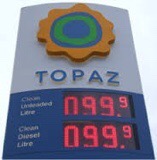
Look at the petrol prices …   #pisky

It is one of the delightful ironies of Ireland that here on the northern edge of Donegal we are to the north of most of Northern Ireland – yet are in the Irish Republic.  The reason for that is simple.  When the line was drawn to delineate the partition of Ireland, three of the counties of the historic province of Ulster were left out of Northern Ireland – to make sure that Northern Ireland would have a permanent protestant/unionist majority.  So when we head for Blogstead Na Mara at Dunfanaghy, we cross the Irish border just outside Derry/Londonderry – sometimes called ‘stroke city’.  The casual visitor could easily miss it.  There is a slight change in the road surface, speed limits are suddenly in kph.  And the petrol prices continue to be expressed in sterling but the prices are Irish – so diesel is suddenly 99.9p per litre.
I’m old enough to have seen several phases of life on the Irish border.  When I was a child growing up in Enniskillen in the west of Northern Ireland, I remember the IRA border campaign of the mid-1950’s.  And there was the period when crossing the border meant a long queue to get a stamp in a book.  During the Troubles, it often meant a long wait, some questioning and a search.  My best memory is of travelling alone with cats to Donegal on Easter Sunday evening during a foot and mouth epidemic.  The Irish Police politely asked if I would take the cats out and get them to walk across a disinfectant mat.

Since the Belfast Agreement, the border has been quietly becoming like other borders in mainland Europe between member countries of the EU – hardly visible at all.  Derry has gradually been regaining its position as the main town for the whole north-west of Ireland including Donegal which is across the political border.

So it is not surprising that in the EU Referendum the Foyle constituency – which includes Derry – recorded the third highest vote in the UK for ‘remain’. Nobody knows – but that vote reflects a real concern that this softening border with its confusion of fuel prices will become a ‘hard’ border between the EU and a UK which has embraced Brexit.

The Somme  #pisky #anglican

‘There were four cottages over there.  The telegraph boy came to every single one of them’

That was said to me in the course of an everyday pastoral call in my parish in Portadown.  The Somme remains very real to me because it was very real to that community.   Thousands of soldiers from every part of Ireland lost their lives – but the Northern Irish losses were concentrated in the Ulster Division.

Ireland has a way of holding history in such a way that it has power in the present.  It’s where history and myth interact.  The Somme has been like that – particularly in the way it lay at the heart of the Orange Order parading disputes around Drumcree.  For some it was a Service which gave rise to an unwelcome parade.  For others it was a very special thing – a commemoration of the loss of the ‘sons of Ulster’.  To let it go would have been a betrayal of memory of past sacrifice and loss of present identity.

So much of this is about things which are of symbolic importance.  And, while it is possible with great determination to negotiate the substance of things, it is difficult to negotiate symbolic issues.